
Vectorless RAG
Skip embeddings entirely. Build a tree index from document structure, summarize nodes with an LLM, and use structured output to find the answer. RAG without a single vector.
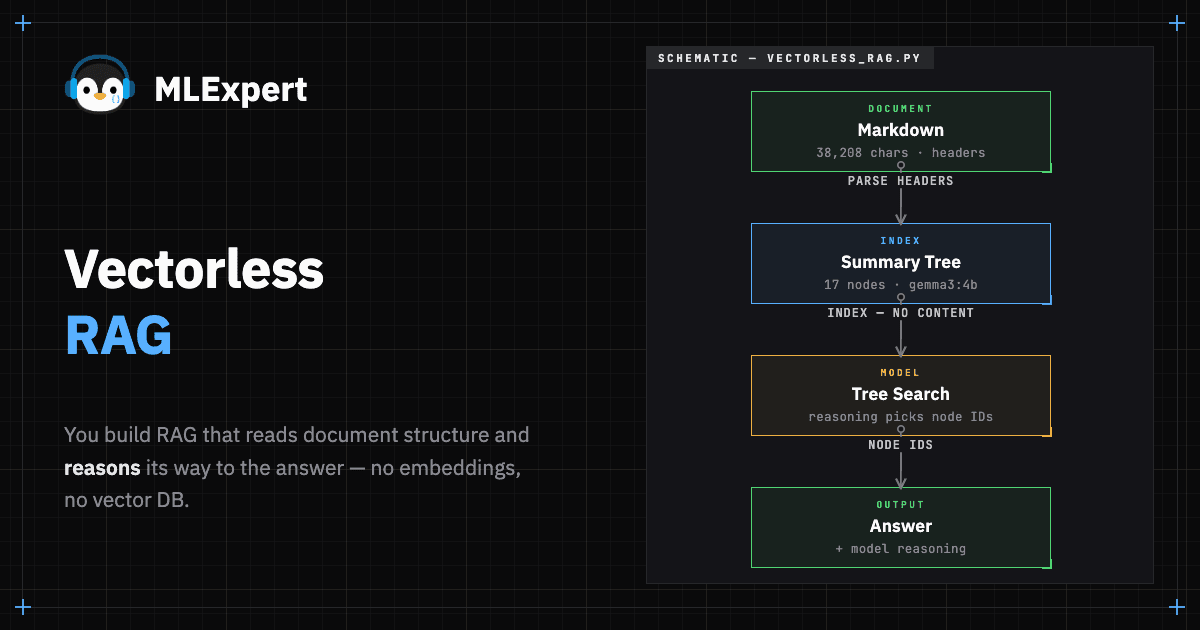
Every RAG tutorial starts the same way: chunk your document, embed the chunks, store them in a vector database. But open any earnings report and look at the table of contents. The document already tells you where everything is. Headers, sections, subsections - a built-in index that we flatten into vectors and throw away.
Vectorless RAG keeps that structure. Parse the document's hierarchy into a tree, summarize each node with an LLM, and at query time the model reads the tree index - titles and summaries, no content - and reasons about which nodes contain the answer. No embeddings, no vector math, no database.
What You'll Build
- Parse markdown into a hierarchical tree structure
- Generate bottom-up LLM summaries for each node
- Use structured output for reasoning-based retrieval
- Build a complete RAG pipeline without any embeddings
How It Works
- 01All 6 modules · 40+ hands-on tutorials
- 02Source code, repositories, and architecture diagrams
- 03Portfolio artifacts: apps, APIs, eval reports, dashboards, capstones
- 04Live sessions + every recording
- 05Discord community access
- 06Certificate of completion with public verification URL
30-day money-back guarantee. One email, full refund.