
Streaming API with FastAPI
Move from local scripts to production-ready APIs. Learn to wrap your LangChain logic in a FastAPI service, enforce data schemas with Pydantic, and stream responses to clients using Server-Sent Events (SSE).
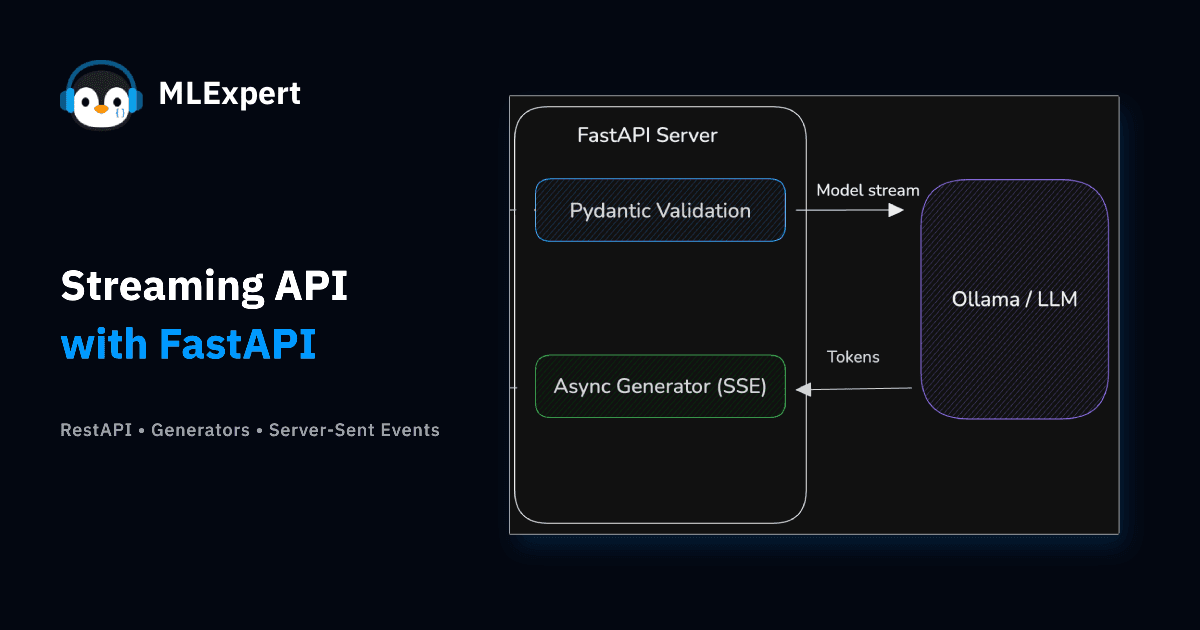
You have a working LangChain script that generates text and follows instructions. But right now, it is in a local Python file on your laptop.
To build a real product, you need to expose that logic with an API. And because LLMs can be slow, a standard "request-response" HTTP call won't cut it. Your users will leave if they stare at a loading spinner for 5+ seconds. You need Streaming.
In this tutorial, we will take the logic you built in the previous lesson and wrap it in a FastAPI1 service. We will enforce strict data contracts using Pydantic to protect your model from bad data, and we will implement Server-Sent Events (SSE)2 to push tokens to the client in real-time, drastically reducing perceived latency.
Tutorial Goals
- Wrap LangChain logic in a high-performance FastAPI backend
- Define rigid data contracts using Pydantic to reject malformed requests
- Implement Server-Sent Events (SSE) for real-time token streaming
- Understand Python generators vs standard functions
- Build an asynchronous Python client to consume the stream