
Welcome to MLExpert
The start of your journey to becoming an AI Engineer and building real-world AI systems
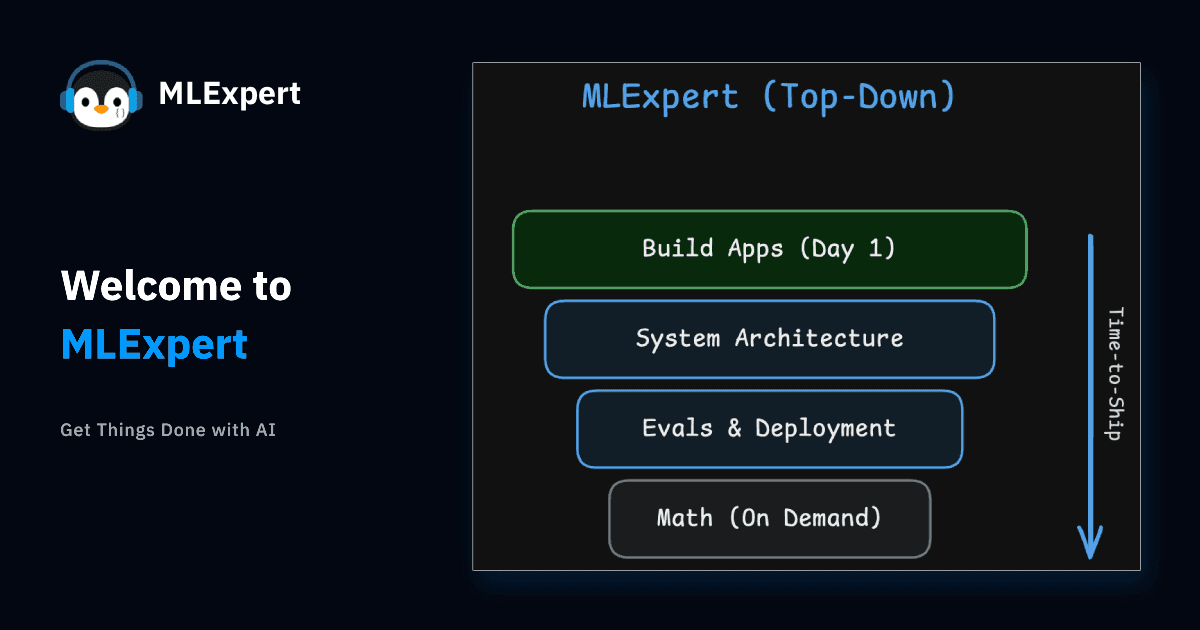
Welcome to the MLExpert Academy. I'm glad to have you here!
Congratulations on taking the steps towards becoming a better AI Engineer. I know that it can be challenging to find the right resources and the right path. You're in the right place. Here, I'll give you a quick overview of what you can expect to achieve by the end of the journey.
In this Academy, you'll build first. You'll deploy. You'll learn the math only when you need to debug the system. Start by watching the video below:
Top-Down Engineering Philosophy
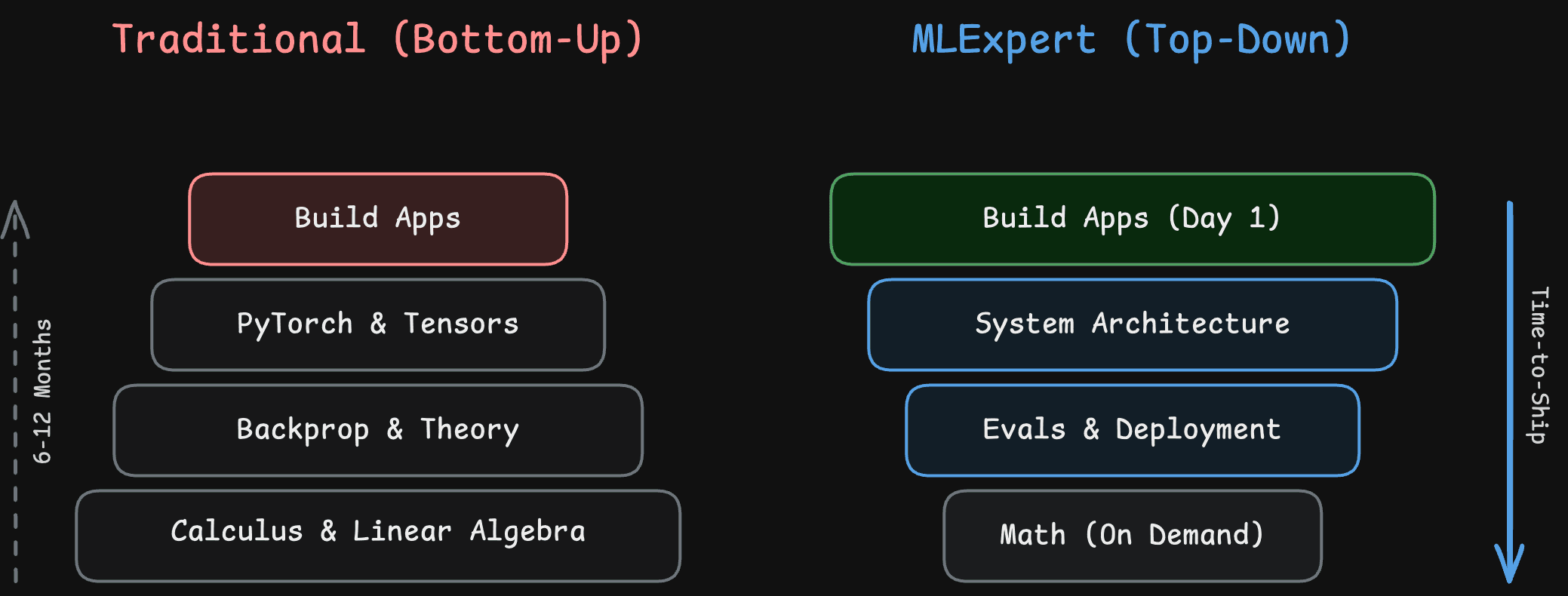
The diagram above illustrates two fundamentally different ways to master Artificial Intelligence.
The Path on the Left (Bottom-Up) is the traditional academic route. You start with Linear Algebra, move to Calculus, study optimization theory, build a neural network from scratch in NumPy, and finally (months later) you build a useful application. Nothing wrong with this path, but you might need to build your AI app and put it in production before you can really understand the math.
The Path on the Right (Top-Down) is the MLExpert approach. We invert the pyramid. If your goal is to ship products, solve business problems, and get hired as an AI Engineer, this is your path. This method prioritizes "Time-to-Ship".
It's Still Going to Get Hard
You won't skip the hard stuff, you'll simply encounter them at the right time.
Think of it like learning to drive. You do not need to understand the thermodynamics of an internal combustion engine to drive to the grocery store. You just need to know how to use the steering wheel and the pedals.
However, if your car breaks down on the side of the road, that is when you open the hood and learn how the engine works.
We apply this same logic to AI:
- Build: you'll use high-level abstractions (LangChain, Ollama) to build a working system immediately. You get the "win" of a functioning app.
- Observe: you'll see where the system fails (hallucinations, latency, costs).
- Debug (Deep Dive): Now you have a reason to learn the math. You peel back the layers to understand Attention mechanisms and Embeddings because you need to fix a specific problem and understand the limitations of the methods you are using.
By the time you get to the math in Phase 4, you won't be asking "Why am I learning this?" You will be asking "How does this help me optimize my RAG pipeline?"
You are here to build. Let's get started.
The Roadmap
You are not here to watch videos; you are here to acquire skills. This curriculum is designed to take you from a developer who can call an API to an engineer who can architect an intelligent system.
Here is the path you will walk:
The Toolkit
You'll stop relying on web UIs and expensive APIs. You'll set up a professional local environment using uv and
Python. You learn to run, control, and engineer models on your own metal using Ollama and LangChain.
Project: NeuroMind — A persistent, memory-enabled AI assistant running locally.
Context Engineering
The most in-demand AI skill is connecting LLMs to proprietary data. You'll master RAG (Retrieval-Augmented Generation), Vector Databases, and Hybrid Search to make LLMs use your data.
Project: The Financial Analyst — A system that reads PDFs and answers complex queries with citations.
Agentic Orchestration
You'll move from linear workflows to cyclical graphs. You'll build Agents that can plan, use tools, browse the web, and write files using LangGraph and the Model Context Protocol (MCP).
Project: The Autonomous Research Team — A multi-agent system that collaborates to produce reports.
Data & Fine-Tuning
Now you'll open the black box. You'll learn the mathematics of Attention and Tensors not for exams, but to debug and optimize. You'll generate synthetic datasets and Fine-Tune small models to outperform giants on specific tasks.
Project: The SQL Specialist — A fine-tuned model that writes perfect database queries.
LLMOps & Production
localhost is easy; production is hard. You'll containerize your agents with Docker, deploy them to GPU Clouds,
and set up Prometheus/Grafana observability stacks to monitor costs and latency.
Project: Enterprise Deployment — A fully secured, load-balanced AI API.
Classical Foundations
AI didn't start with ChatGPT. You'll explore the foundational algorithms—Regression and Classification—that still power high-frequency trading and fraud detection systems today.
Project: Predictive Pipelines — Building non-LLM machine learning systems.
How to Learn
You'll not just watch someone else code for 20 hours. This is not a Netflix series.
To ensure you actually acquire these skills, every module is structured using a format called The Lesson Sandwich.
1. The "Why" & Architecture (Video)
Watch this first. It shows you the system architecture and the final result. This gives you the mental model of what you are building before you see a single line of code.
2. The Deep Work (Text)
This is where you spend 80% of your time. The code and a guide to help you understand the code.
- Do not just copy-paste. Read the explanations.
- Type the code out if you are a beginner. It builds muscle memory and understanding.
- Read the file paths. The project structures mirror production software, not scripts.
3. The Verification (Video)
Once you finish building, watch this. I'll show you the final code running. If your terminal output matches mine, you pass. If it doesn't, you'll need to debug it.
The Reality of AI Engineering
Things will break. AI libraries update weekly. CUDA drivers conflict. APIs get deprecated. When you hit an error, do not panic. This is the job. Debugging broken dependencies is a third of an AI Engineer's salary. You'll get the solutions, but you must bring the resilience.
Capstone Projects
Each module ends with a Capstone Project. This is not a tutorial. This is a mission.
I will not give you the code. I will give you a Scaffold—a professional repository structure with the dependencies configured and the logic stripped out. You will receive an Engineering Spec (similar to a Jira ticket) detailing the requirements.
To pass a module, you must:
- Download the scaffold
- Implement the missing logic
- Push your code to GitHub
- Submit your repository URL for review
Upon submission, you unlock the Solution Code and a Code Review Video where I walk through my implementation, highlighting common pitfalls and optimizations. This ensures you leave every module with a portfolio-ready project that you built.
Logistics & Housekeeping
Let's get the administrative details out of the way so you can start coding.
Get the Code
All source code for this academy is hosted in private GitHub repositories. You'll get access to them within a couple of hours of joining the academy (sometimes GitHub invites take some time to send). Each tutorial will have a link to the repository for the project.
Join the Community
You are not building alone. Join the Discord Server. This is where we share updated config files when libraries break, discuss job offers, and debug edge cases - Join the Discord.
Hardware Requirements
Modules 1-3: A standard laptop (MacBook M1/M2/M3 or a Windows/Linux machine with 16GB VRAM) is perfect. We'll use optimized, quantized local models. If you have a more powerful machine, you'll be able to run larger models and do it more efficiently.
Modules 4-6: You will need a GPU. Do not go out and buy a $3,000 card. If you have 4090 or up, you'll do just fine. Oterwise, I'll show you how to rent GPUs using cloud services.
Prepare for the Journey
Have any questions? You can reach out to me at venelin@mlexpert.io. I don't use any chatbots or automatic responses, you'll contact me directly!
And now it is time to get started. In the next lesson, you'll setup your environment!